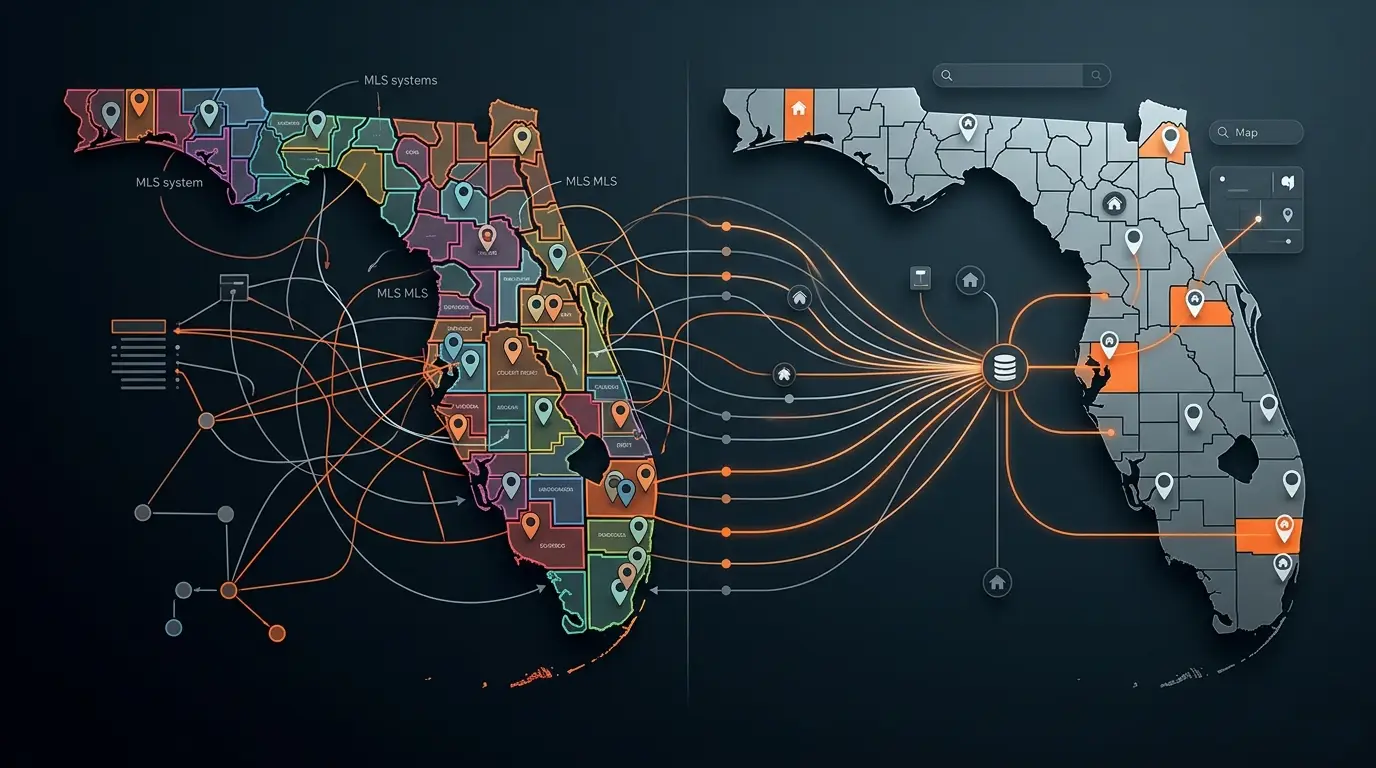
Florida MLS fragmentation is one of the biggest structural problems in Florida real estate today. Instead of a single, unified database, Florida’s real estate data is divided across more than 20 separate MLS networks. This fragmented system is costly for agents, limits exposure for sellers, and creates unnecessary friction for buyers. In an internet-first world, the current Florida MLS system is outdated and inefficient. Here’s why Florida MLS fragmentation is a real problem and how a statewide MLS solution can fix it.
How Florida MLS Fragmentation Creates Overlapping Territories
Florida’s MLS landscape is a patchwork of regional and local databases, many covering only a few counties each2. Some areas even have overlapping MLS coverage, which is bewildering for agents, and detrimental to sellers. Broward County in South Florida is a prime example: it falls under two different MLS boards,one run by the Broward/Palm Beaches/St. Lucie Realtors (BeachesMLS) and another by the MIAMI Association of Realtors. If an agent lists a Broward property only in the Broward-centric MLS, the home won’t appear on as many websites or reach as many buyers as it would if listed on MIAMI’s MLS. In other words, sellers can unknowingly lose exposure simply because of which MLS their agent uses for that county.
Similarly, Florida Keys listings historically required navigating three separate MLS boards (Key West, Marathon/Lower Keys, and Upper Keys), a byproduct of local association boundaries that have little to do with consumer logic. These overlapping jurisdictions can lead to confusion (Which MLS has the “official” data for that area?) and cause some agents to waste time double-entering listings or partnering with co-listing agents just to ensure a property shows up everywhere. It’s an archaic scenario rooted in old geographic fiefdoms.
The consumer impact of this fragmentation is real: sellers in overlapping areas may get incomplete marketing if their agent isn’t a member of every relevant MLS, and buyers might not see all options if they or their agent rely on just one MLS feed. In a world where information flows globally online, it’s jarring that a buyer in Orlando might miss a Broward home simply due to MLS silos.
Florida MLS Fragmentation Forces Multiple Memberships and Fees
For real estate professionals, Florida’s MLS fragmentation isn’t just inconvenient, it’s expensive by design. Each local MLS typically requires membership in the local Realtor association plus separate MLS subscription dues. An agent who wants statewide reach might end up joining 2, 3, or more boards, stacking hundreds of dollars in redundant fees per year just to access the listings their clients need.
Why does this costly structure persist? Data control and fee revenue. Historically, MLSs emerged from local broker groups and associations that guarded their data and membership dues. Even though technology long ago eliminated the need to physically visit association offices or flip through printed listing books, the fragmented system remains – and local associations have a financial incentive to maintain their piece of the pie. As a result, Florida agents as a whole likely pay millions annually in duplicated MLS fees across the state to uphold a model that mainly benefits those selling the memberships.
Consider that access to one major MLS in Florida often costs $800–$1,200/year when you combine national, state, local, and MLS fees. If you need two or three MLS subscriptions, that can double or triple. Those are resources that could have gone into marketing or client service, but instead get spent on maintaining multiple logins and bureaucracy. For newer or part-time agents, paying thousands per year for overlapping MLS access is especially burdensome.
Defenders of the status quo claim that regional MLSs offer local expertise and tailor rules to local needs10. It’s true Florida’s markets differ, Miami condos vs. Panhandle beach houses, but these differences don’t require separate databases and dues. A single statewide MLS could easily support local data fields and rules without forcing agents to join separate organizations for each county. The real drivers of fragmentation are independent governance and revenue: each association wants to keep its autonomy (and dues) and has little incentive to voluntarily merge.
In short, fragmentation thrives because it locks in revenue streams for each local board, but at the cost of efficiency and clarity for everyone else.
Florida MLS Fragmentation Leads to Incomplete Exposure and Data Gaps
Fragmentation doesn’t just cost money, it directly affects how well properties get marketed. In a unified system, every buyer’s agent sees every listing statewide. In Florida’s reality, a listing might be visible to only a subset of agents/buyers if it’s stuck in one MLS silo. Sellers bear the brunt of this with reduced exposure:
If an agent only belongs to “MLS A” covering certain counties, their seller’s listing won’t show up for agents using “MLS B” covering adjacent counties. The seller might miss out on offers from those other areas, just because of data silos.
Even on public real estate portals, fragmentation causes incomplete listing feeds. Many assume sites like Zillow or Realtor.com automatically show everything, but that’s no longer true in Florida. Zillow, for instance, is now missing listings that aren’t syndicated under new rules. Due to policy changes in 2024–2025, Zillow stopped pulling from certain MLSs or requires special permission to display listings. As a result, buyers using only Zillow see only a fraction of what’s actually for sale. Put simply: Zillow doesn’t show every Florida listing anymore, not by a long shot.
Meanwhile, some local MLS boards limit how widely their data is shared, as mentioned earlier with Broward vs. Miami MLS sharing differences. A Broward-listed home might not get syndicated to as many real estate websites as a Miami-listed home. The overlapping local control thus leads to uneven online visibility, depending on which MLS an agent uses.
For buyers and sellers, this is confusing and frustrating. Sellers rightly expect their home to be “on all the sites,” but fragmentation means no single site actually has it all. The irony is that the closest thing to a comprehensive Florida listing search today isn’t an MLS at all, it’s using multiple aggregator websites or hiring an agent with multi-MLS access. In fact, many Florida agents now warn buyers not to rely solely on one portal: “If you’re using just Zillow, you might miss homes that sold before you even saw them online”.
Portal Data Gaps: A tangible example: today, Zillow’s Florida search shows roughly 255,000 homes for sale, but Realtor.com (which aggregates all MLS feeds) lists over 300,000. That’s a difference of tens of thousands of listings not surfacing on Zillow, and buyers (and sellers) pay the price in lost opportunities. Zillow’s new “Listing Quality” policy, essentially banning listings not quickly put on an MLS has further complicated what shows up, and it even triggered a lawsuit and backlash from some brokerages. (CoStar’s CEO Andy Florance called Zillow’s move “a power play… not about protecting consumers”).
So where can you see every Florida listing? Arguably, on Homes.com or Realty.com, newer national portals less entangled in the MLS politics. Homes.com, for example, has actively positioned itself as an agent-friendly portal willing to display all listings, even launching a feature to “boost” any listings that Zillow/Redfin won’t show. For consumers, though, hopping between sites to piece together the full inventory is hardly ideal. A straightforward solution would be a single MLS that covers the state, so that one feed truly equals all listings.
Why Florida Needs a Statewide MLS to Fix MLS Fragmentation
It’s increasingly clear that Florida’s industry is hungry for consolidation. Even the big Realtor-run MLS organizations have started partnering to break down barriers. In 2025, Stellar MLS (Central Florida’s large MLS) and MIAMI Realtors (South Florida) launched a reciprocal access deal allowing each other’s members to see all listings without extra fees. This was a landmark collaboration explicitly meant to “unify fragmented listing access” and relieve agents from “maintaining multiple costly memberships”. Brokers hailed it as “long overdue… a relief from MLS fragmentation headaches”. In 2026, those two associations even announced an official merger to unify South Florida’s MLS networks into one giant system. These moves show that even within the Realtor world there’s recognition that the patchwork is unsustainable.
However, waiting for every local board to merge or align could take years (if not decades). Agents and brokers need a solution now – which is where a true statewide MLS comes in. MyStateMLS is one such platform already making waves. Unlike traditional MLSs tied to local associations, MyStateMLS is a statewide (actually nationwide) MLS that any licensed agent can join directly. It removes geographic restrictions, letting you list and search anywhere in Florida (and beyond) with one membership.
Key benefits of a statewide MLS like MyStateMLS:
Complete Coverage with One Login: In MyStateMLS, every Florida listing is available in one database, so agents and their clients see the full market without juggling several systems. No more “which MLS is that property in?” It’s all in one place. For agents, this means no multiple logins or interfaces to learn for different regions; for brokers, it simplifies training and compliance.
Lower Costs & No Duplicate Dues: With a statewide MLS, agents pay one set of fees for one membership that covers the whole state, not five different bills to five associations. MyStateMLS, for instance, charges a flat membership rate (often comparable to a single local MLS fee) but covers all of Florida and even other states. An agent can drop their redundant local MLS memberships and save hundreds or thousands per year while still getting MLS access everywhere they need.
Neutral, Business-as-Usual Operations: One concern some have is “Will a new MLS have the same cooperation and standards?” With MyStateMLS, the answer is yes: offers of compensation to buyer’s agents are handled normally (the platform still shows co-broke commissions to members, keeping cooperation incentives transparent as usual). It’s built to be familiar for Realtors, with full broker cooperation, IDX feeds, and nationwide syndication. In other words, it preserves the proven benefits of MLS (like cooperation and standardized data) without the baggage of local silos.
Statewide Exposure for Every Listing: If an agent lists a home on a statewide MLS, every other member of that MLS across Florida will see it, maximizing that property’s exposure. No Florida buyer’s agent is left out. Sellers can rest easy knowing their property is reaching the entire state’s buyer pool, not just one corner. It’s effectively the same promise as having to join all local MLSs (statewide reach), but delivered via one platform.
Greater Flexibility and Agent Autonomy: A statewide MLS empowers agents to serve clients beyond traditional “territories”. If your client moves from Tampa to Naples, you don’t need to refer them out or join a new board – you’ve already got access via the statewide MLS. Agents licensed in multiple states (common in North Florida or for those doing Southeast FL & Georgia, etc.) can leverage a platform like MyStateMLS to handle multi-state listings seamlessly, again with one membership.
Of course, transitioning to a statewide MLS may raise questions. Some longtime practitioners worry about losing local influence or specific data fields. But modern MLS technology can accommodate regional customizations within one system, for example MyStateMLS supports local custom fields and rules, so that nuances of Miami condos vs. rural land in the Panhandle are all properly handled. The difference is those listings still live in one database instead of being balkanized.
Conclusion: Time for Florida’s MLS Evolution. Agents, Lead the Way
Florida’s current MLS regime, a mosaic of overlapping, association-bound fiefdoms – served its purpose in a bygone era. But clinging to this fragmented model now primarily serves those collecting the fees, while agents and consumers bear the downsides of duplication, confusion, and incomplete information. As one industry observer noted, fragmentation persists not by necessity but by “institutional incapacity” to change. It’s time to push past that inertia.
The good news is, change is already afoot: the largest MLS players are consolidating and independent options like MyStateMLS offer immediate statewide MLS access to those ready to break free now. No one’s suggesting local expertise or service be lost. Agents will always be the local market experts for their neighborhoods. But how data is shared and how much we pay to share it must evolve.
Call to action for Florida’s real estate pros: Demand better. Support efforts to unify MLS access, whether by encouraging local boards to collaborate or by adopting statewide platforms that give you full market coverage without the nonsense. If you’re tired of paying multiple MLS dues or finding out a buyer never saw your listing, know that there are alternatives and the industry’s trajectory is toward fewer, broader MLSes. By embracing a statewide MLS model now (and perhaps rethinking the need for mandatory association ties), you send a message: that data cooperation should transcend old borders and that agents and brokers deserve a simpler, more transparent system.
In the end, our goal is the same: maximize exposure for sellers, simplify workflows for agents, and ensure buyers have access to every available home. A statewide MLS achieves that far better than a fractured patchwork ever could. It’s time to move from fragmentation to unity, and Florida’s agents and brokers can lead the way to this overdue change.